How modern pentathlon's obstacle discipline works, and how athletes qualify for LA 2028

· · 6 min read

At the Los Angeles 2028 Olympics, modern pentathlon will be held without horses for the first time since it entered the Games in 1912. Show jumping has been replaced by an obstacle race: two athletes side by side on a 70-metre course with eight obstacles, racing for a buzzer. The change followed the riding scenes at Tokyo 2020 and several years of disputes inside the sport, and it now has a written rulebook and an IOC-approved qualification system.

This explainer covers how the obstacle discipline is run and scored under the Union Internationale de Pentathlon Moderne (UIPM) rules in force since February 2026, how it fits into the pentathlon day, and how the 64 athletes for LA 2028 will be selected.

Why riding was dropped

The decision followed the women's riding event in Tokyo, when Germany's Annika Schleu struggled with her allocated horse, Saint Boy, and a German coach was seen striking the horse after it refused a fence. In November 2021 The Guardian reported that the UIPM's executive board had voted to remove riding, initially with cycling named as the replacement, and that some countries were already objecting. Kate Allenby, an Olympic bronze medallist for Britain at Sydney 2000, told the paper the change would be a "disaster" for the sport.

The UIPM confirmed the process on November 4, 2021. Its announcement said the executive board had met on October 31 and unanimously endorsed the Innovation Commission's recommendation that riding be replaced. The new discipline had to meet set criteria, including not falling under another IOC-recognised federation, being easy for TV and digital audiences to follow, being low-cost for athletes and organisers, and keeping injury rates low. All changes would take effect for LA 2028, after Paris 2024.

Obstacle racing was chosen in 2022. BBC Sport reported that the UIPM described it as "compatible with the DNA of modern pentathlon" and cited its lower costs, accessibility and appeal to young people. Opposition remained strong. The group Pentathlon United said a survey of 310 past and present athletes found 95 percent unhappy with the change, and Britain's Tokyo champion Joe Choong was among the signatories of a letter to the IOC saying athletes had "lost faith" in the sport's leadership. Modern pentathlon was also left off the provisional LA 2028 programme while the question was unresolved. It was put back on by the 141st IOC Session in Mumbai in October 2023. The IOC's announcement said the UIPM still had to change its governance and modernise, and was blunt about the reason: "Without the replacement of horse riding with obstacle racing, the sport would not have been included in the programme."

Before that decision, the UIPM ran four obstacle test events in 2022. Its summary of the feedback reported satisfaction of almost 90 percent among about 200 participants, most of them juniors and youth athletes. The same release acknowledged that the IOC had withheld modern pentathlon's place on the LA 2028 programme until the UIPM could "make a compelling case" for it. Paris 2024 was the last Olympics with riding. BBC Sport's Paris guide noted that riders there were allocated an unfamiliar horse in a draw just 20 minutes before competing.

The course and the race

The UIPM Competition Rules and Equipment Regulations, dated February 1, 2026, set out the obstacle discipline in Chapter 3. The course uses eight obstacles over 70 metres, for both individual and relay events. It can be straight, curved, or U- or V-shaped, with up to 10 percent extra length allowed to compensate for curves. At Category A competitions, races are always head to head.

For junior and senior athletes, six obstacles are fixed and two are drawn:

  1. Steps
  2. Big Wheel
  3. Tilting Ladders
  4. Over-Under-Through
  5. Draw 1: Wheels, Flying Hoops or Ascension Bars
  6. Giant Steps
  7. Draw 2: Rings, Climbing Holds or Swinging Globes
  8. Finish Wall

The two drawn obstacles are chosen at the first technical meeting for the qualification rounds and drawn again before the semi-finals, with that second draw also applying to the final. Athletes may "run, walk, jump, climb, crawl, slither, scramble, lift, carry, or otherwise propel themselves" through each obstacle, within that obstacle's rules. On the Steps, for example, touching the steps with the hands is forbidden. Athletes finish by hitting the buzzer with their hands, arms or forearms, and times are recorded to a hundredth of a second.

Scoring and penalties

Times convert to pentathlon points on a fixed table. A run of 15.00 seconds is worth 400 points, and each 0.33 seconds slower costs one point. On the table, 25.00 seconds earns 370 points and 45.00 seconds earns 310.

Mistakes are handled in steps. The first failure on an obstacle brings a warning. The athlete can retry by continuing to the end of the obstacle, going around the vertical truss and returning to its start along the outside. A second failure on the same obstacle means elimination, as does touching the trusses or crash mats on an obstacle where the athlete has already been warned. Gloves, tape and chalk are banned and also lead to elimination. A false start costs 10 points, and jostling or obstructing an opponent leads to disqualification. Athletes must wear athletic shoes without spikes.

The chapter opens with an unusual clause. Because athlete performance improved quickly during the discipline's introduction, the UIPM Executive Board reserved the right to amend the obstacle rules after the 2025 season "to ensure the continued integrity and equity of the competition."

Where obstacle sits in the day

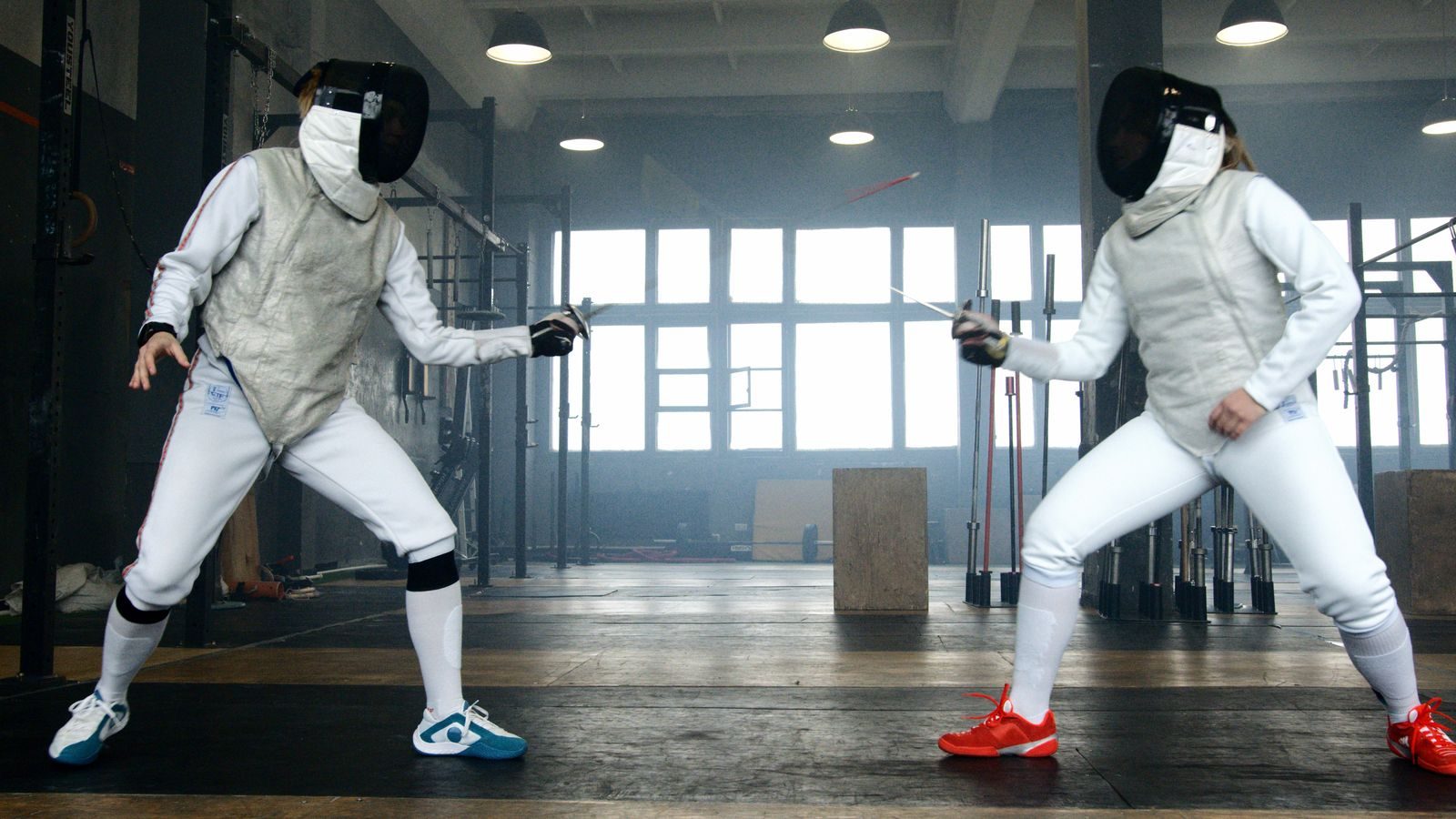
In the semi-finals and finals of Category A competitions, the rules set the order as fencing, obstacle, swimming and laser run. There is a five-minute break between fencing and obstacle, five minutes between obstacle and swimming, and ten minutes before the laser run, which always uses a handicap start. The short breaks belong to the elimination format the UIPM's 2021 announcement described, which "enables audiences to watch all five disciplines in 90 minutes."

How the 64 places for LA 2028 are allocated

The UIPM's LA28 qualification system, in the version of May 12, 2026, provides for one individual event per sex. Each has 29 qualification places, one host country place and two universality places, giving 32 men and 32 women, or 64 athletes in all. Paris had 72, according to the BBC. A country can enter no more than two athletes per sex.

The 29 qualification places per sex are allocated as follows:

  • 2027 World Cup Final, Budapest: 1 place
  • 2027 continental championships: 20 places (Africa 1, Asia 5, Europe 8, Oceania 1, Pan America 5), with a maximum of one per country per continent
  • 2027 World Championships, Budapest: 1 place
  • 2028 World Championships, Cairo: 3 places
  • Olympic world ranking, June 2028: 4 places

The ranking counts each athlete's five best results between January 1, 2027 and June 5, 2028, with no more than three from the same calendar year. Every Olympian must also have competed in at least one ranking event in 2028. A start that ends with a DNF or an elimination still counts, but a DNS or a disqualification does not.

What to watch before 2028

The obstacle rules are now settled enough for qualification but not fixed. The Executive Board's right to amend Chapter 3 after the 2025 season means course details could still change before Los Angeles. On the points table, every third of a second is one point, so four seconds lost on a failed attempt at the Rings or the Swinging Globes costs about 12 points before any elimination risk. Whether the new discipline reshapes the sport's traditional order, in which Hungary had won 23 Olympic medals before Paris according to the BBC, will start to show at the 2027 World Championships in Budapest.

For another multi-discipline event where one part of the race can decide the result, see how biathlon's shooting penalties decide races.