How biathlon's shooting penalties decide races before the finish

· · Updated · 7 min read

Biathlon is the Winter Olympic sport where a race can be decided by a few millimetres of steel. An athlete arrives at the range with a racing heart rate from a loop of hard skiing, drops into the prone position, and has five shots at five targets whose scoring aperture is 45 mm across, from 50 metres. Each one left standing costs either a lap of a 150 m loop or a full minute, depending on the race. Skiing speed sets the ceiling; shooting sets the floor.

The rules governing all of this are public. The International Biathlon Union publishes its Event and Competition Rules and their annexes, and the current edition, Version 2026, specifies the loop, the range, the targets and the sanctions in detail. This piece reads those documents alongside the glossaries the IBU and broadcasters have produced for Olympic audiences.

Two kinds of punishment

Table 1 of the IBU Event and Competition Rules sets out, for every class and format, the shot penalty imposed for each target left standing after all rounds for a bout have been fired. Column 8 of the table defines it as either added time, one minute or 45 seconds, or a penalty loop of 150 m or 75 m. Which applies depends entirely on the competition.

For senior men the 20 km Individual, skied as five loops of 4 km with four shooting bouts in the order prone, standing, prone, standing, carries a 60-second penalty per miss. The 15 km Short Individual uses 45 seconds. The Sprint (10 km, three loops of 3.3 km, prone then standing), the Pursuit (12.5 km), the Mass Start (15 km) and the Relay all use the 150 m loop. The Single Mixed Relay and the Super Sprint use a 75 m loop. Women's distances are shorter, with the Individual at 15 km on 3 km loops, but the penalty structure is the same.

The IBU's own Olympic glossary explains the practical difference. A penalty loop is skied immediately after the bout and is visible to everyone in the stadium. A time penalty is invisible until the clock stops, which is why the Individual is the format where a leader on the course can be a long way down on the results board.

What the range looks like on paper

What the range looks like on paper

Article 3.4.2.1 of the ECR requires the distance between the front edge of the shooting ramp and the line of targets to be 50 m, plus or minus 1 m. Looking downrange, the right half of the range is for prone shooting and the left half for standing, except in Pursuit, Mass Start, Super Sprint Final and Relay competitions, where athletes fire from any lane in both positions.

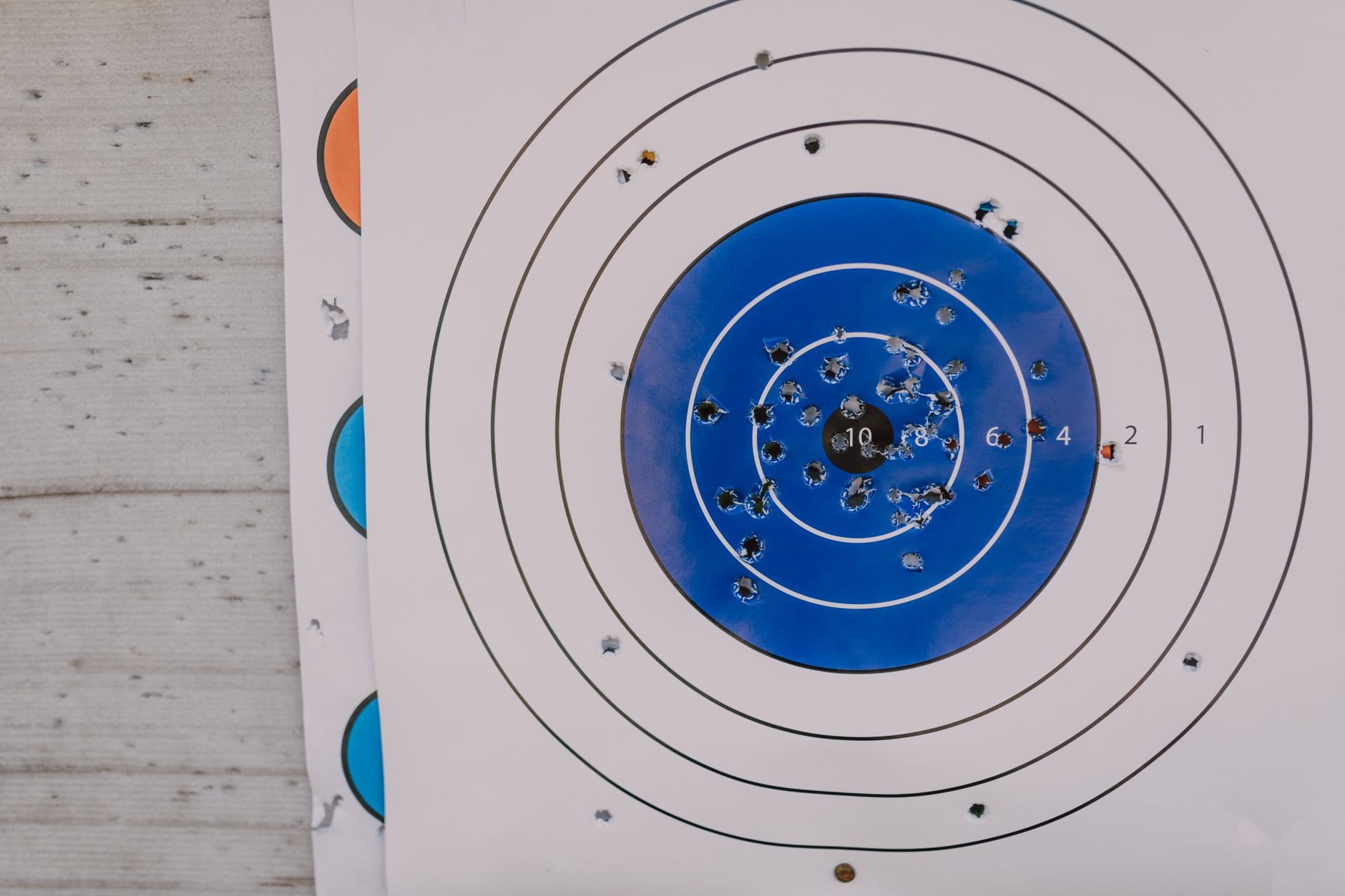
The targets are specified in Annex A. For standing, both the aiming area and the scoring aperture are 115 mm in diameter. For prone, the black aiming circle is still 115 mm but the scoring aperture is 45 mm, with a tolerance of 0.3 mm. Paper targets carry a dotted line at 40 mm for prone and 110 mm for standing. Hit a prone plate anywhere inside the 45 mm circle and it registers a hit; hit the black outside it and the target stays up.

The rifle is a 5.6 mm (.22 inch) rimfire with a minimum weight of 3.5 kg and a trigger resistance of at least 0.5 kg. Annex A also limits the impact momentum of a bullet fired from 50 m to 0.9 Ns, which is the number that keeps the target mechanisms consistent from venue to venue. Only standard .22 long rifle rimfire ammunition is allowed.

The loop itself

Article 3.3.11 describes the loop with the precision that explains why televised penalty laps look so similar from venue to venue. It must be set up immediately after the shooting range, no further than 60 m skiing distance from the right edge of the range to the entrance: an oval trail 5 to 6 m wide and 150 m long, plus or minus 5 m, measured along the inside perimeter, or 75 m for Super Sprint and Single Mixed Relay. The opening must be at least 15 m long, the loop is fenced with V-boards set so close together that no athlete can mistake the entrance or exit, and it must sit on level ground so that entering it adds no extra distance.

NBC's Olympic explainer translates 150 m as just under 500 feet, and notes that in the relay the loop is only triggered by targets still standing after the eighth shot, because relay athletes carry three spare rounds per bout that must be loaded by hand. US Biathlon's format guide adds the start structures that make the loop decisive: the Pursuit sends the top 60 off in sprint-result order, and the Mass Start puts the top 30 on the line together, so a loop skied in the final standing bout is a lead handed directly to the athlete behind you.

Cross-firing and the two-minute penalties

Misses are not the only sanctions. Article 11.3 of the ECR lists time penalties of 30 seconds, one minute and two minutes for specific errors, separate from the shot penalty. Two minutes is charged for every penalty loop not skied immediately after the bout that earned it, for every round left unfired when an athlete leaves the mat early, for cross-fire, for starting a relay leg without a tag, and for firing more than five rounds in a bout, or more than eight in a relay. Thirty seconds covers shooting from the wrong position or sequence, or the wrong place in the lane, and under Article 8.3.5 any hits made that way are not scored, so the athlete also takes the missed-target penalty for them.

Cross-firing has its own procedure in Article 8.7.3. If someone fires on your target, you raise a hand and the range official stops the other athlete; if a plate has fallen, the target is reset and you fire your remaining shots on it, with the hits recorded first so the official can tell you how many loops you owe. If you cross-fire onto an empty neighboring target, the official shouts Cross-Fire, you may finish on the correct target, but hits on the wrong one do not count. Article 8.7.4.1 makes the responsibility clear: the Competition Jury adjusts time for target malfunctions or range problems, never for an athlete's own error.

Why the penalty structure shapes who wins

Because a loop is paid for at skiing speed, the strongest skiers can afford more misses than the field in loop formats. A 150 m lap costs roughly the time it takes to ski 150 m plus the entry and exit, so the cost is lower for a fast skier than for a slow one, while the minute in the Individual is the same minute for everyone. That is why the Individual rewards pure shooters and the Mass Start rewards athletes who can miss once and still catch the pack.

The formats have accumulated over decades. US Biathlon's guide records that the Relay entered the Olympic program at Grenoble in 1968, the Mass Start at Torino in 2006 and the Mixed Relay at Sochi in 2014. NBC's guide to the 11 events at Milano Cortina 2026 lists five events for men and five for women plus the mixed relay, with the Individual carrying the 60-second penalty and everything else the 150 m loop. Written before the Games, the guide noted that the United States had never won an Olympic biathlon medal, and that Deedra Irwin's seventh place in the Beijing 2022 women's 15 km Individual was the best-ever Olympic finish for Team USA. That gap is the one this site examined in its piece on Norway's winter sports system: nations that produce fast skiers who can also shoot clean have a structural edge in a sport where every miss has a price written in the rulebook.

If you watch a biathlon race with the rulebook in mind, the information you need is on screen: the format, the bout number, and the count of targets still standing. In a Sprint or Mass Start, add the loop time for a fast skier and you can see whether a lead survives. In the Individual, add a minute per miss to the course time before you believe the leaderboard.

The IBU posts the current Event and Competition Rules and annexes on its downloads page. All the figures above come from Version 2026, which carries the amendments made by the IBU's 2026 Congress.